
Gold Reaper EA — what it is and how I run it
This page contains an affiliate link. If you buy through it I may receive a small commission at no extra cost to you. It doesn't change what I write, and I only write about EAs I've tested on live accounts. If you'd rather not use my link, go straight to the developer's own website instead — the product and the price are the same either way.
At a glance
Developer: Wim Schrynemakers (Profalgo)
What it is: a breakout system trading XAUUSD on multiple time frames, built around several internal strategies you can switch on and off
Grid or martingale? No, though the multiple strategies mean more than one position can be open at a time
Risk level in my view: moderate, and higher than my FX systems because gold is gold
Short version: the strongest system on my accounts, and the one that most requires you to leave it alone
What it is and how it works
Gold Reaper trades breakouts on XAUUSD during the London and New York sessions. What makes it unusual is that it isn't one strategy but several, each with its own entry logic and its own magic number, which you can enable or disable individually.
That modularity is the whole appeal. Rather than accepting or rejecting the EA as a block, you can run the parts of it you're comfortable with. I take advantage of that heavily.
Gold is not just another instrument, and it's worth being clear about why that matters here. Spreads are wider and widen further around news and rollover. Daily ranges are far larger in absolute terms. A stop distance that represents sensible risk on EURUSD is noise on XAUUSD. Any gold system has to be built for that from the start, and plenty of EAs that merely permit gold trading are not.
Where the risk sits
Positions carry stops, but because several strategies can be active at once, your exposure at any moment is the sum of what they're all doing rather than a single trade. Size accordingly.
The characteristic you most need to understand is that this system is tail-dependent. A small proportion of trades produce a large share of the result. When I went back through my own history, the best tenth of trades accounted for roughly forty per cent of the profit.
That has a practical consequence that catches people out. If you close winning trades early because you're nervous, or interfere with the trail, you remove precisely the trades the system depends on and you're left with the losses. The right way to run this is to let it finish what it starts. Intervening because a copier has failed or a lot size is wrong is fine. Intervening because you don't like how a trade looks is not, and it will cost you.
Expect flat stretches. They're the price of the occasional very good month, not evidence that something has broken.
The settings I run
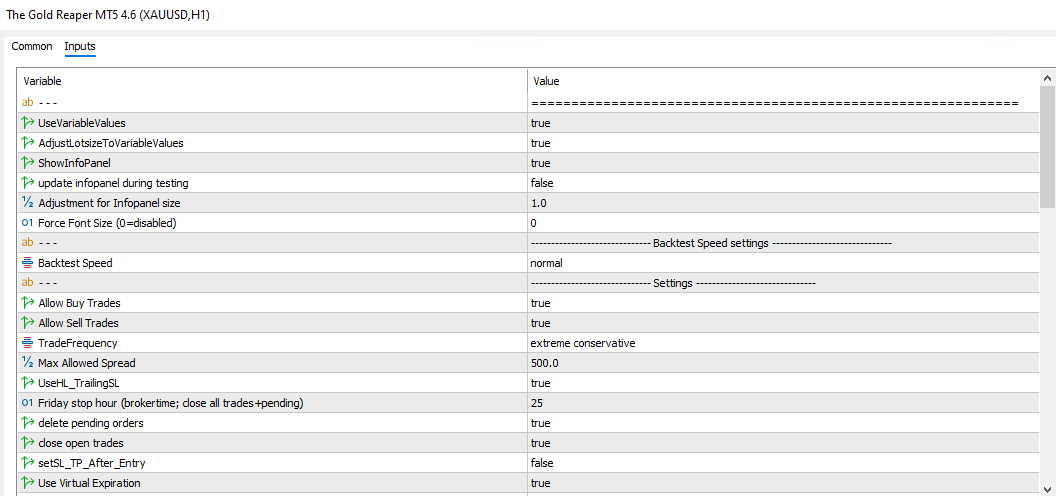
I run it in its extreme conservative trade frequency mode with only the first three internal strategies enabled, which is more restrictive than the default.
Now the thing that took me longest to work out, and which I'd want anyone buying this to know straight away.
MaxAllowedDD is not a circuit breaker. The name strongly implies that the EA will stop trading if drawdown reaches that level. It doesn't. It's an input to how lot sizes are calculated. I found this out by halving it, expecting a more cautious version of the same system, and instead getting every strategy flattened to the broker's minimum lot. If you want an actual account-level stop, you have to impose it yourself, from outside the EA.
Two smaller things in the same category. The take-profit adjustment input applies as a global offset across strategies that have very different targets, so it doesn't do what you'd expect and I've left it alone. And the second and third strategies have no take profit set at all, which is by design, but it means you shouldn't go looking for one.
One practical note on MetaTrader: it caches previous input values per EA, so if you're updating to a new version, remove the EA from the chart, recompile, reattach and reset the inputs. Also remove any pending orders. Otherwise you'll quietly be running old settings and wondering why the behaviour doesn't match.
What I like
The modular strategy design is genuinely useful and rare. Being able to isolate three strategies out of the set and run only those is what lets me hold a gold system at a risk level I'm comfortable with, rather than having to accept the developer's whole configuration or nothing.
The developer is also active and the system has been maintained rather than sold and abandoned, which is not a given in this market.
What to watch
Give it more account headroom than you'd give an FX system. Gold's ranges are larger and undersizing the account is the most common way people come unstuck with any gold EA.
Watch your broker's gold spreads. They vary between brokers far more than FX spreads do, and a configuration that's comfortably profitable on one broker can be marginal on another.
And don't fiddle. This is the system where interference does the most damage, for the tail-dependency reason above.
Who it's for, and who it isn't
For someone who wants gold exposure in an automated portfolio, has the account size to absorb gold's volatility, and can genuinely leave a system alone through a quiet stretch.
Not for a small account, and not for anyone who checks the terminal several times a day and finds it hard not to act. The temperament required here is different from the technical requirement, and it's the one people underestimate.
Verdict
The strongest performer on my accounts, run deliberately conservatively. I'd rather have three strategies I understand at minimum lot sizes than the full set at defaults, and I think that's the right way for most people to approach it.
Buy it understanding what MaxAllowedDD does and doesn't do, put your own account-level limit around it, and then leave it alone.
Questions
What account size do you need for a gold EA?
More than for an equivalent FX system. Gold's daily ranges are much larger in absolute terms, so the same lot size carries considerably more risk. Work out what a normal adverse move actually costs on your account before going live rather than assuming the defaults were chosen with your balance in mind. I’d say a minimum of $2000 though probably.
Does MaxAllowedDD stop the EA trading at that drawdown?
No, and this is the most important thing on this page. It feeds the lot sizing calculation. Reduce it and you don't get a more cautious version of the system, you get every strategy trading at the broker minimum. If you want a hard stop at a given drawdown, you need to enforce that yourself.
Should I run all the strategies?
You can. I don't. I run the first three in conservative mode, which is a deliberate choice to trade less and understand more of what's happening. Start restrictive and add rather than the other way round.
Does broker choice matter for gold?
Yes, more than for FX. XAUUSD spreads vary substantially between brokers and widen around news and rollover. Test on a demo with your own broker before committing, because a system that works on one may not on another.
Where can I see verified results?
The developer publishes a verified track record, which is where to look rather than taking figures from me. Forexeasolutions.com
New to running a gold system? This article covers what makes the instrument different before you commit money to it. Or ask me directly — happy to talk through whether it fits what you're doing.
Software only. This is another developer's product and I don't control how it performs. Nothing here is financial advice or a forecast of returns. Trading carries risk, including losing more than your deposit on leveraged products. High Tide Trading is not authorised or regulated by the FCA.